List of official bloggers announced for Microsoft’s Convergence 2013
Posted: March 13, 2013 Filed under: Uncategorized | Tags: Convergence, networking, social media 1 Comment Jon Rivers of Data Masons just wrote this article about how Microsoft is showcasing the role of social media at Convergence 2013. http://www.datamasons.com/blog/2956/the-social-experience-elevating-social-media-at-microsofts-convergence-2013/
I’m happy to announce that I’m also one of the official bloggers on the list this year, and will be joining 11 other bloggers during the conference in keeping attendees in touch with the pulse of Convergence during the week. Microsoft is providing all of the bloggers with Surfaces to keep us mobile, traveling light, and connected and is also providing a Social Media Command Center to give attendees a place to charge devices, sit, and observe or engage in social media activities.
Jon’s article lists all of the official bloggers, make sure to look it over and add these experts to your list of social media sources to watch during the week.
If you haven’t already, and especially if you’re not able to attend this year, subscribe to Dynamics NAV Financials through my email link, RSS Feed, or Facebook page; or for up to the minute updates, follow on twitter @krosvold!
The finance professional’s perspective on NAV dimensions (part 3 of 15)
Posted: March 13, 2013 Filed under: Uncategorized | Tags: dimensions, financial statement, general ledger, NAV, tips and tricks Leave a commentAs the finance person for your company who will make decisions about dimensions, you bring a unique perspective to how dimensions can be valuable in your accounting department. Some of the concerns you have will surround reporting requirements, some will pertain to consistency and control, and others will relate to efficiency. Let’s go through each of those concerns.
Efficiency
As a corporate controller, I’m concerned that my staff work in an efficient manner. In regard to coding invoices or general ledger entries, this means they shouldn’t need to look up a lot of information and they don’t engage in any more data entry than they absolutely have to. When choosing how dimensions will be set up in NAV, you can make some specific choices regarding how data can be populated. Do you want the coding to come in as a default value? Are your coding relationships rule-based enough to make that possible? Are there some things you can populate to always default so the coding appears as if by magic 100% of the time and an employee never needs to be responsible for making a coding decision?
Consistency and Control
In the same way that I’m a stickler about operating efficiently, I’m even more so about having consistency and control. If you ever work with me, at some point you will hear me say, “we do not allow optional data”. This means we don’t gather dimensions for some data and not for others. I use the default value code mandatory a lot in my system. This setting will force a dimension to be populated whether it is through a default value or by a person, but it will never allow the data to come through with a blank value, creating holes and reduced value data in my reporting.
Reporting Requirements
Ultimately, you’re using dimensions in your ERP system so you can get great reporting out of it to make important business decisions. As your company’s finance professional, you know what you’re reporting on now. Take a minute to think about that. Is what you’re reporting on still relevant or is it what you’ve always reported on? Has your business changed? Does your reporting need to change too? Think about what your business really needs to see in its reporting and structure your dimension choices to match.
Keep reading this month as we continue our series, 15 Days of NAV Dimensions.
NAVUG spotter at Convergence: Where will you find international users?
Posted: March 12, 2013 Filed under: Uncategorized | Tags: Convergence, NAVUG, networking, user group Leave a comment This year, the NAVUG (NAV user group) is more active at Microsoft Dynamics Convergence than ever before, offering 19 sessions given by end users who use the software every day at their companies! For the first time ever, there are two international business sessions being offered by end users. If you are looking to make connections with users who utilize NAV with a global or international emphasis in their businesses, these sessions are the place to be.
Sydney Stroyer is an International Supervisor with Bally Technologies and Jesus Carbajal is Head of Information and Systems at Nissin Foods of Mexico. These two speakers, along with Alexander Lutz, Head of Microsoft Dynamics NAV at metabowerke GmbH, in Germany, will also be hosting a Hot Topics Roundtable on International Installations on Monday.
Don’t forget there is also an International Lounge at Convergence this year, located in the Atrium Cafe, next to the Starbucks.
Microsoft Dynamics NAV: How to Approach an International Deployment UBNAV05 Monday, March 18 1:30 PM – 2:30 PM
Would you like to network and share experiences with users with global deployments of Microsoft Dynamics NAV? If your company is running Microsoft Dynamics NAV in more than one country (or plans to!) join us and share your experiences. We’ll explore how your company has addressed challenges with operating Microsoft NAV on a large scale and/or on a multi-country scale. Share your experiences and in turn listen as peers share their knowledge on international installs. *Hosted by NAVUG*
Microsoft Dynamics NAV & Global Finance Accounting CSNAV14; Thursday, March 21 4:00 PM – 5:00 PM
5 reasons you need to use NAV dimensions (part 2 of 15)
Posted: March 12, 2013 Filed under: Uncategorized | Tags: accounts payable, dimensions, financial statement, general ledger, NAV, tips and tricks 1 Comment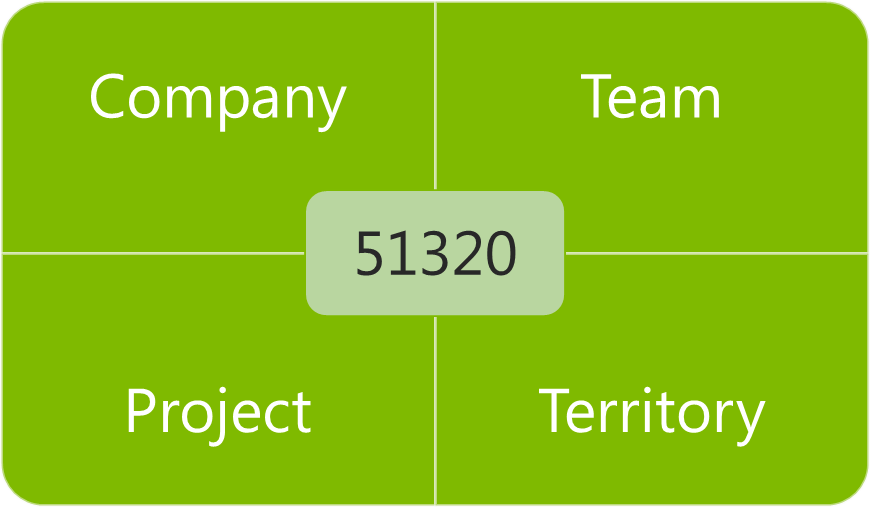 Still not convinced that leaving your old multi-segmented chart of accounts behind is a good idea? Don’t know exactly what in the world that crazy grid illustration with a number in only one box and words in the rest has to do with accounting, at all? Here are my five reasons for why you should be using dimensions.
1) Your chart of accounts is shorter. Seriously now, my company was the one with the 4,000 accounts in the chart of accounts before we installed NAV. We used project codes heavily, and had three to four segments to each base general ledger account number. Every member of the accounting team had this gigantic dog-eared book on their desk they would reference as they went through their day. Not only was it impossible to remember all that detail, it took a long time to type those numbers into the system, and with so many manually entered numbers, it was very easy to make a mistake. We spent a full two days every month during the close investigating and researching whether things went into the right place and then constructing reclassifying entries to correct the errors. My chart of accounts is less than 200 accounts now, and we eliminate a few more every year.
2) Account coding becomes intuitive. We still use project codes heavily, but now we’re able to give them a name as well as a number, which makes the coding process much more intuitive, less prone to error, and allows people outside the accounting department to enter data into the system. We work with a lot of non-numbers people at our company, and just talking about money has become easier since we started using dimensions. Nobody needs to get out the big dog-eared book to “determine the coding for your recent T&E”. We can use actual English and say things like, “Code that expense report to the Marketing team for the recent children’s sunday school event in Ohio” and everyone knows where that will be coded when the invoice gets entered to NAV.
3) Better control and accuracy. Certainly with having more intuitive coding and a shorter chart of accounts, we should all see some improvement in control and accuracy of postings. But wait, there’s more! NAV does a fantastic job of layering in more features for dimensions like allowing automatically populated default values, adding warning messages to make sure you get the right kind of dimension in the right place, allowing control at the level of your master data as well as your chart of accounts, and allowing restrictions on what dimensions can be combined with other dimensions and with what priority. All of these features combine to make sure the computer does the work instead of your employees and does it more accurately. Remember those two days my company used to spend to review and correct entries with reclassifications? Last year, I was able to send out an email out for three month end closes letting my team know they had a perfect posting month – no errors – not a single reclassification.
4) Greater flexibility in your reporting. Even with this shorter chart of accounts, we actually have more detail than we had before, because getting more detail through use of dimensions makes it possible. The idea of adding another segment in the old system to support a changing reporting need was heinously prohibitive. With dimensions, we gain that flexibility without adding another 400 pages to our chart of accounts. We produce more reports with more valuable information now than ever before, and we have the ability to combine the data we’ve gathered in more flexible combinations to assist us in making business decisions.
5) You’ll continue to have more options, even after go-live. I think a lot of people believe the only time they can make decisions about dimensions is when they are initially implementing. While this is a very important time to lay the foundation for your NAV system, you do have the option to add or change dimensions as you go along. We’ve actually added about one new dimension annually, as our business needs have changed, and as we’ve determined we need to report on different priorities.
Keep reading this month as we continue our series, 15 Days of NAV Dimensions.
4 questions to ask when deciding how to use NAV dimensions in your business (part 1 of 15)
Posted: March 11, 2013 Filed under: Uncategorized | Tags: chart of accounts, dimensions, NAV 1 CommentIf you’re just getting started with Microsoft Dynamics NAV for your business, you’ve probably heard the term dimensions, but you don’t really know what that means yet. You may be someone in the finance area for your company, or you may be an IT person. Eventually, at some point in your planning process, your partner is going to have “the talk” with you. This is an important talk, and it can be a little scary or even a little bit embarrassing, but it is absolutely necessary. The talk will probably start with, “have you thought about how you’ll clean up your chart of accounts”, or “we need to discuss how you will restructure your chart of accounts”, or “you could realize some serious efficiencies in your posting processes by reducing your chart of accounts”, or “holy cow, 4000 accounts is a whole lot, how do you remember all that?”.
Here are the four questions you should be asking yourself when deciding if you need to use dimensions at your company:
1) How long is your chart of accounts?
2) Do you recognize a number that looks like this? 01-810-51320-627539
3) How often do you answer this question? How do I code . . .
4) How many reclassifying entries are you making every month?
You might get the idea by now that using dimensions allows you to clean up your chart of accounts, reduce it in size, and increase your efficiency by doing so, and you would be exactly right. At its most basic, using dimensions will allow you to replace your old multi-segmented account numbers

with something that looks a little bit more like this.
Keep reading this month as we continue our series, 15 Days of NAV Dimensions.
It’s Convergence time! Where will you find the NAV people?
Posted: March 11, 2013 Filed under: Uncategorized | Tags: Convergence, NAV, NAVUG, networking, user group 1 CommentAnyone who knows me will nod their head and smile if you describe me as a compulsive planner. I have a white board in my office and my kitchen, my best friend will be happy to tell you an old college story about me and excessive use of index cards, and I’ve already been using my Convergence Schedule Builder for weeks. The biggest question I have every year is: where will I find the NAV people? With projections of over 11,000 attendees in 2013, it can be a serious challenge to find folks to network with who are using the same ERP solution. Here’s my list of where I’ll be looking for other people who use NAV every day, just like I do. 
1) Watch for any session labeled with ID, these are interactive discussions and are generally your best bet to find like-minded NAV professionals. The bonus of attending these sessions is that participants are encouraged to interact and discuss the topic during the session. This is a great opportunity to ask questions of other NAV users, but is also a great chance to introduce yourself to someone later. Catch them in the hall with a quick, “that was a great point you made on database optimization in that last session” and you’ve got an instant conversation starter.
2) NAVUG, the NAV user group, is giving a session on Wednesday at 12:30 titled “Get to know NAVUG – your resource group for all things Microsoft Dynamics NAV”. If you haven’t been involved with the user group yet, this is a great way to hear what they’re all about, meet a few folks, and see what they have to offer during the year. The user group also has a booth in the Expo hall.
3) Go to the ILOVENAV.com booth, also in the Expo hall. This is a wonderful group of people who are looking to give NAV users a voice, using idea crowdsourcing, in what happens next with their chosen ERP solution.
4) Head to the Microsoft help desk. There is sure to be a line of people waiting for their appointed NAV guru to help them solve business challenges. Most of the folks standing there will also be NAV users, so don’t hesitate to strike up a conversation.
5) Watch for the user group banner in the meal hall. There’s generally a banner somewhere in the meal hall that indicates a special roped off area for user group members. Do not be intimidated by the rope! If you’re looking to meet other NAV users, come on in and come on over! Folks in the NAVUG are always happy to meet a fellow NAV user.
See you there!
15 days of NAV dimensions
Posted: March 11, 2013 Filed under: Uncategorized | Tags: Account Schedules, Convergence, CustomerSource, dimensions, Dynamics, NAV, NAV 2013, tips and tricks 1 CommentMarch Madness may mean basketball for some folks, but for me it means Convergence! Getting a chance to participate as a speaker at Microsoft Dynamics Convergence is a great opportunity to meet new NAV users I haven’t met before. I’m always looking to expand my network of knowledgeable professionals, and one of the ways I do that is by sharing information.
I’m lucky enough to be giving a concurrent session this year called Tips & Tricks for Working with Dimensions in Microsoft Dynamics NAV and I thought I would put together a series for the blog on the same topic to get the information out to a wider audience. For the next 15 days, there will be a brand new post on one of these dimension topics. Enjoy!
Day 1 4 questions to ask when deciding how to use NAV dimensions in your business
Day 2 5 reasons you need to use NAV dimensions
Day 3 The finance professional’s perspective on NAV dimensions
Day 4 Why finance and IT need to work in partnership on a NAV dimension strategy
Day 5 Viewing NAV dimensions on postings: where can you see them?
Day 6 NAV default dimensions and value postings applied to master data
Day 7 NAV default dimensions and value postings on the chart of accounts
Day 8 NAV dimension combinations for additional accuracy
Day 9 NAV dimension priorities
Day 10 Resolving NAV dimension errors
Day 11 NAV dimensions in account schedules
Day 12 NAV dimensions in budgets and consolidations
Day 13 Communicating to IT about NAV dimensions and NAV2013 dimension sets
Day 14 Add NAV dimensions as your business changes
Day 15 Learning more about dimensions from Microsoft Dynamics Customer Source
BONUS View Convergence 2013 session on Microsoft Dynamics NAV dimensions here
This posting is one of the Top 20 Most Viewed in the last year! Follow this link to see the entire list.
PowerPivot to the People
Posted: March 5, 2013 Filed under: Uncategorized | Tags: BI, Excel, Microsoft, NAV, Office2013, PowerPivot Leave a commentAs a Controller at a small to medium-sized business, I struggle with the big BI question: do I invest in a business intelligence package or do I do it myself?
When I first became aware of PowerPivot, a free Excel add-on that became available with Microsoft Office 2010, I was excited and also a little relieved. While the emergence of PowerPivot didn’t completely solve my dilemma, it sure gave me some significant options for more data accessibility. I didn’t have to depend on my partner or an IT employee with special skills to build me a dataport from NAV, or to piece together an SQL query, or to build a cube I could apply queries to. Because I have PowerPivot, suddenly I can be Super-Controller; accessing tables directly in my NAV database, pulling ginormous amounts of data into a single spreadsheet, and manipulating the data with lightning speed into familiar Excel pivot tables, all without asking for help. 
So, when I read in a recent article from MSDynamicsWorld.com that New Office 2013 Licensing May Put PowerPivot, Power View Out of Reach for Some Microsoft Dynamics Users, I was actually pretty alarmed and then pretty upset. How dare Microsoft give us this shiny new Christmas dream and then snatch it away like some kind of horrible data-reneging Grinch!
I went looking for a few more answers about exactly what was going on, and what I found out was that Microsoft has actually taken PowerPivot out of most versions of Office 2013. This is a big deal because it was previously available in all versions of Office 2010, so Microsoft is actually removing functionality. PowerPivot is only available in Office 2013 if you get Office Pro Plus through volume licensing or through Office 365 subscriptions. Basically, this means PowerPivot is not available in any retail Office 2013 packages, so therefore, is only reachable by companies who have enough purchasing power to utilize volume licensing packages. So, a tool that was designed, in my opinion, to give BI power directly to the people by making it simple enough for financial folks to pull their own data, has now been restricted to only business class licensing. If you’re looking for some interesting theories as to why this might be, read Hey, Who Moved My (PowerPivot 2013) Cheese?
Mr. Excel himself (Bill Jelen), the uberist Excel geek of them all, has some great stuff to say about PowerPivot, including “PowerPivot is the best new feature to hit Excel in 20 years” and a few other things here including a great short video explaining why we should care. I just said in a recent NAVUG Ask the Experts Finance webinar only two weeks ago that as a financial professional who uses NAV, learning to use PowerPivot should be the most important skill finance people should learn in the next year.
Microsoft has missed a huge opportunity to finally settle a score in the BI arena for small to medium businesses by making this move. There has always been the argument that using Excel spreadsheets is a risky proposition for financial professionals. You can really create some big problems for yourself if you are not careful in how you manage your spreadsheets. Some companies even go so far as to outlaw them and attempt to go spreadsheet free. Companies who sell BI packages lean on this pretty hard, trying to remove spreadsheets from the list of available choices.
I say this risk is greatly offset by the benefit of being able to use a tool that can pull, in a safe way, massive amounts of data that can be manipulated by the typical Excel end-user quickly and efficiently. For me, the benefit PowerPivot brings to my company tips the scale on sinking money into a BI solution, and keeps me firmly in the DIY BI camp, with Excel as my primary tool. Making PowerPivot available in all new versions of Excel seals the deal and makes BI in Excel a revolution of equality, ensuring equilateral Excel adoption in the business world.
I’m glad to see so many people bringing forward a call to action to bring PowerPivot back to all versions of Office, not just Pro Plus and Office365 subscriptions. I’m adding my voice, and will continue to ask Microsoft to bring PowerPivot to the people!
This posting is one of the Top 20 Most Viewed in the last year! Follow this link to see the entire list.







 Dynamics NAV Financials